
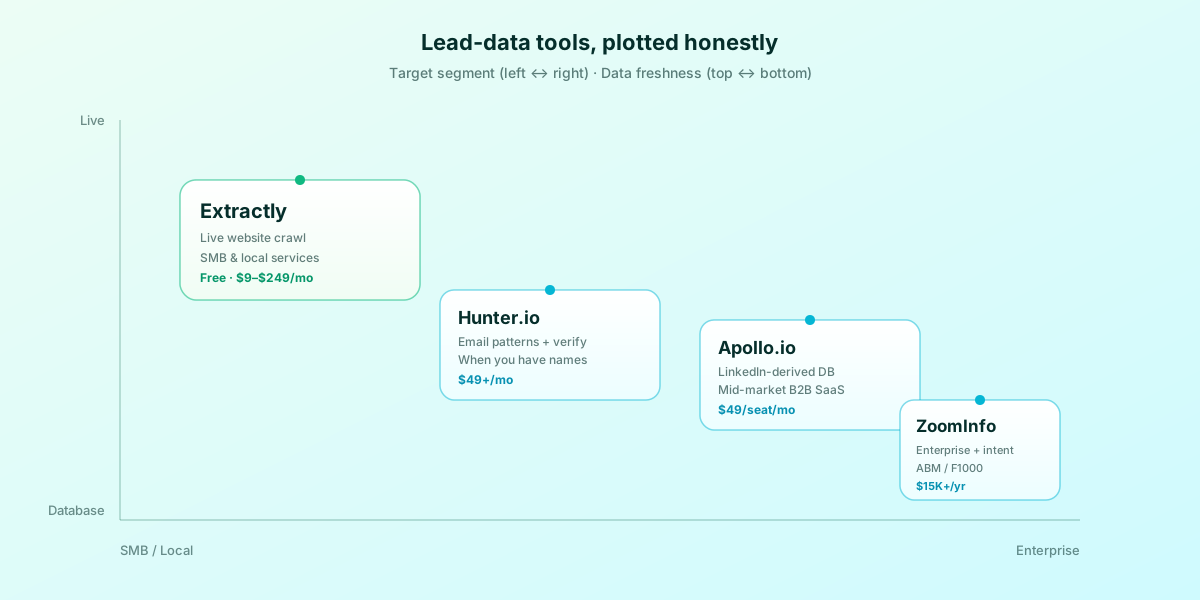
Note on this post: I run a competing product, Extractly, which appears in the comparison. I've tried to be honest about where the other three tools beat us — there are several places where they do. All pricing and feature claims are from each company's public pricing page as of May 2026 (linked in each section). Where I'm stating an opinion, I say so.
If you've spent more than a week shopping for a sales lead-data tool, you've probably hit the same wall I did when I started building Extractly: every category page lists the same four or five names with vaguely overlapping descriptions, and nobody tells you which one you should actually buy.
This is my attempt at a fair answer. I'll go through Apollo.io, ZoomInfo, Hunter.io, and Extractly the way I'd explain them to a friend who asked me at dinner — what each one does well, what it doesn't, and where the prices land in 2026.
The four tools, at a glance
Before the long version, here's the shortest honest comparison I can give:
| Tool | Best at | Free tier | Paid starts | Pricing model |
|---|---|---|---|---|
| Apollo.io | Mid-market B2B prospecting with LinkedIn-style filters | 60 credits/mo | $49/user/mo | Per-seat, monthly or annual |
| ZoomInfo | Enterprise account-based selling, intent data | None (trial only) | Custom (typically $15K+/yr) | Annual contract, sales-led |
| Hunter.io | Quickly finding an email address for a known person at a known company | 25 searches/mo | $49/mo | Per-search, monthly |
| Extractly | SMB and local-business lead gen, owner-level data from live websites | 50 leads/mo | $9/mo | Per-lead, monthly |
If you only have 30 seconds, here's the decision tree: Are you selling to Fortune 500 buying committees? ZoomInfo. Are you a mid-market SDR with a $49/seat budget and need 1,000+ contacts a month? Apollo. Do you have a name and a company and just need one email? Hunter. Are you targeting SMBs, local services, or vertical markets where the owner's name is on the company website? Extractly.
The rest of this post is the why.
Apollo.io
Apollo's pricing page puts their basic paid plan at $49/user/month. The product is essentially a searchable database of around 275 million B2B contacts that Apollo has compiled by scraping LinkedIn, public web sources, and customer-contributed data, then enriched with firmographics, technographics, and intent signals.
What Apollo is genuinely best at. Filtering. If you want "VPs of Marketing at SaaS companies in the US with 50-500 employees who use HubSpot," Apollo will give you a list in 90 seconds. The filter surface is wide and the contacts mostly exist — most importantly, the LinkedIn-based people data lets you find individuals at companies whose names aren't on their public website. That's the core thing none of the other three tools in this comparison can do at the same scale.
Where Apollo falls down, in my experience. Three places. First, freshness — the database is refreshed on a rolling cycle, and any given contact can be days to many months old. For high-velocity outbound, that bounce rate adds up. Second, SMB coverage — Apollo's data is much thinner for businesses under 50 employees and for owner-operated local businesses, because those people aren't on LinkedIn the way enterprise sellers are. Third, the contracts are seat-based, so a 5-person sales team is $245/mo before you do anything serious.
When to pick Apollo. You're selling B2B SaaS or services to mid-market or enterprise companies, your reps are heavy LinkedIn users, and you need a wide filter surface more than you need fresh data. If you're prospecting Salesforce, HubSpot, Stripe — companies whose org charts live on LinkedIn — Apollo is genuinely the right tool.
ZoomInfo
ZoomInfo is the most established player in this category and the most expensive. They don't publish pricing — getting a quote means a sales call — but most teams I've talked to who use it pay somewhere between $15,000 and $50,000 per year, depending on user count and which modules (SalesOS, MarketingOS, OperationsOS) they buy.
What ZoomInfo is genuinely best at. Enterprise account-based selling. ZoomInfo's people-data graph is deep at the F1000 level — they have contacts at companies the other tools have never heard of, accurate org-chart relationships, and (this is the real differentiator) intent data, which tells you when a company is researching topics that suggest they're in a buying cycle. For ABM motions targeting 100-500 specific accounts, ZoomInfo is the canonical choice.
Where ZoomInfo falls down. The price excludes most companies under Series B. The annual contract excludes most early-stage teams who can't predict their lead-gen needs 12 months ahead. The procurement cycle alone takes weeks. And in 2024-2025 there was sustained criticism that ZoomInfo's data freshness — particularly for contacts at smaller companies — didn't justify the price premium over Apollo. I haven't run that test myself, but the volume of complaints suggests the issue is real.
When to pick ZoomInfo. You have a defined ABM strategy, your average deal size is over $50K, you need intent data, and you can absorb a five-figure annual commit. If you're a Series C+ company selling to mid-market or enterprise, the answer is often ZoomInfo even when the cheaper tools would technically work.
Hunter.io
Hunter's pricing starts at $49/month for 500 searches, which is the cheapest of the three established players. Hunter is also the most narrowly focused — they do one thing extremely well, which is finding the most likely email address for a given person at a given company.
What Hunter is genuinely best at. The narrow case. If you have a list of 50 LinkedIn profiles and you need to find each person's email at their current employer, Hunter is the fastest, most accurate tool I've used. They've spent over a decade building pattern databases — when you give them a name and a domain, they generate the most probable email format (firstname@, first.last@, etc.) and SMTP-verify it.
Where Hunter falls down. Two places. First, when the company doesn't have a well-established email pattern — early-stage startups, recently-domain-changed companies, local businesses with mixed conventions — Hunter's confidence drops and the bounce rate climbs. Second, Hunter doesn't help you find people — only emails for people you already know about. You can't say "give me every dentist in Phoenix"; you have to bring the list of dentists yourself.
When to pick Hunter. You already have a target list (from LinkedIn, conferences, a CRM export, etc.) and you need their work emails. For pure email-finding given known names, Hunter remains the best in class. Combine with Apollo or ZoomInfo to get the names in the first place.
Extractly
I'm going to keep my own section short and specific, because nobody trusts a vendor describing their own product. The full pricing is on our pricing page but the short version is $9/mo for 250 leads, $29/mo for 1,000, $79/mo for 4,000, $249/mo for 15,000, and a free tier with 50 leads/month and no credit card.
What Extractly is best at. SMBs, local services, and any business where the owner's name and direct email actually appear somewhere on their public website. The product works by crawling live websites in response to your search query, rather than maintaining a static database. That changes two things: data is as fresh as the business's current site, and we extract the fields that aren't in any database — services offered, pricing, named owners, specialties — because we read each site directly.
Where Extractly falls down. We're terrible at enterprise. If the person you want isn't named on their company's public website — and at large companies, they almost never are — we can't help you. Use Apollo or ZoomInfo. We also don't have intent data, technographics, or LinkedIn-derived signals. We do one thing: extract what's actually on websites, at scale.
When to pick Extractly. Your TAM is local businesses, professional services, clinics, restaurants, or any vertical where each prospect is small enough that the owner publishes their own contact info. Examples: an agency selling marketing to dental practices, a vertical SaaS for med spas, a founder doing competitive research on every yoga studio in a metro.
The honest decision matrix
If I were sitting in front of a whiteboard, this is the chart I'd draw:
| Your situation | Pick |
|---|---|
| Prospecting Fortune 500 buying committees, ABM motion, $50K+ deals | ZoomInfo |
| Mid-market B2B SaaS / services, 50-500 employee targets, multiple SDRs | Apollo |
| You have names from LinkedIn / events, need emails for those specific people | Hunter |
| Targeting SMBs, local services, vertical with named owners on websites | Extractly |
| Bootstrapped, can't commit to per-seat pricing, need to test before buying | Extractly or Hunter (both have meaningful free tiers) |
| Running outbound at agency scale for 5+ clients, mixed verticals | Apollo (primary) + Extractly (SMB fill-in) |
The biggest mistake I see people make is picking the wrong tool for the segment. ZoomInfo will absolutely give you a list of every dental practice in Phoenix — but the data will be older and shallower than what Extractly will hand you, because dental practices aren't a market ZoomInfo invests in maintaining. Conversely, Extractly will give you a list of marketing VPs at Series B SaaS companies — but the list will be tiny, because those people aren't named on company websites the way they're named on LinkedIn.
Match the tool to the segment. That's most of the answer.
A few side-by-side scenarios
To make this concrete, here are three real customer scenarios and how each tool would handle them.
Scenario 1: An SDR at a 10-person SaaS company selling to mid-market e-commerce brands. Their target list is "Head of E-commerce at DTC brands doing $5M-$50M revenue." Apollo wins this. The targets are LinkedIn-active, the filter shape matches Apollo's data model, and $49/month is in budget. ZoomInfo would also work but isn't worth the price premium. Hunter would help find specific emails once they have names. Extractly would be the wrong tool — these contacts aren't on their company websites.
Scenario 2: A marketing agency that sells to independent dental practices. Their target list is "owners of dental practices in 5 metros." Extractly wins this one. The owners are usually named on the practice's About page with a direct email, and the data is hyperlocal. Apollo would give them a thin list of dentists pulled from LinkedIn — many of whom don't run their own practice. ZoomInfo would be expensive overkill. Hunter would only help once they had names, and they don't.
Scenario 3: A recruiter looking to hire a VP of Engineering for a Series B company. Their target list is "VPs of Engineering at Series B-C SaaS companies in the US." Apollo or ZoomInfo wins. The names are on LinkedIn, the seniority filter is precise, and intent data (in ZoomInfo's case) tells you which companies are actively hiring. Extractly is wrong here — VPs of Engineering are almost never named on their employer's public website. Hunter is useful for finding the emails once names are pulled from elsewhere.
What I'd avoid worrying about
A few things I see in comparison articles that I don't think matter as much as people claim:
CRM integrations. Every tool here exports to CSV and most have native HubSpot / Salesforce sync. If your only objection to a tool is "it doesn't have a one-click button," 90 seconds of CSV import does the same job.
Total contact count. "300 million contacts" sounds bigger than "275 million contacts" but for any specific search you run, you're filtering down to a few hundred. Database size is a vanity metric. Quality of filters + freshness matters more.
Chrome extensions. Useful, but every tool here has one. Not a differentiator.
API access. Real differentiator if you're building a workflow, but for 95% of buyers it's a thing they think they want and never use.
Final notes
I started this post intending to write a balanced comparison and I think I've been roughly honest. There are places where I'd rather you pick Extractly than the alternatives, and I've said so. There are also clear scenarios — enterprise prospecting, deep LinkedIn-data motions, intent-driven ABM — where one of the other three tools is the right answer, and I've said that too.
If you want to test Extractly against your current tool, the free tier is real (50 leads/month, no card) and the fairest way to evaluate is to pull the same target market in both and compare the actual owner emails, not the summary stats.
Whichever tool you pick, get out of the comparison-shopping loop quickly. Most of the difference between these tools is segment fit, not feature count, and the only way to know which one fits is to run 50-100 real searches in it.
Last updated: May 18, 2026. Pricing and features taken from each company's public pricing page on that date. If you spot an outdated claim, let me know.